Because... I was traveling.
Because I got a job offer on Thursday.
And because I just spent hours on the road.
I am now in Boston.
New job! New research!
And, more importantly, new busking scene!
Tuesday, December 9, 2014

Monday, December 1, 2014
"What if it rains tomorrow?"
"What if it rains tomorrow? Or, you know, God forbid, a tragedy or
something and you can’t make it! Then what? You’re gonna wish that you stayed
out those extra couple hours no matter what you do when you go home."
I thought that was a metaphor.
It was a figure of speech - an explanation for the work ethic of this one particular Chicago street performer. Despite the freedom of life on the streets, despite the ability to choose where you work, when you work, and for how long you work, there is a specific kind of constraint that comes with that kind of independence.
For one, you lose the safety net that comes with working for a larger company. Paid sick days don't exist: you work, or you don't make money. That would, of course, be the case with any self-employed individual.
But the constraints are more basic than that... and the recognition of that constraint comes when you realize that the metaphor isn't just a metaphor.
I got a text message one afternoon in early June of 2014. In preparation for an observation that day, I asked a busker about his performance schedule. He texted back, "Brought my rig just in case but it doesn't look like this rain is going to let up anytime soon."
What if it rains tomorrow?
Basically? If it rains, you don't work. Or you can try, but your audiences aren't likely to stop. I didn't realize how literal that quote was until Jeremy (a street magician) read my thesis and nodded in agreement with that question.
"You know," he had explained to me, "you could lose money to the weather. Um, a rainy Saturday could be a fairly expensive proposition for a street performer."
One drummer covers up all his gear at the first signs of rain, out of fear that the water would damage his instruments. For him, losing busking income was one thing. Losing the tools of his trade was a bigger risk.
What that means for the performer quoted at the beginning of this post - and what it means for many professional street performers - is that they work even when they don't need the money. They work because one day, it's going to rain, they won't be able to work, and they're going to need savings to fall back on.
There's freedom in street performing - but for the most successful ones, there's discipline as well.
The winter months drive most performers indoors or down south to New Orleans. Some stop busking entirely. Then there are some who, on occasion, face Mother Nature in a tense staring contest. The Tin Man, for example, works every weekend through the winter months in spite of Chicago's biting cold.
Jeremy, known among fellow magicians as a hard worker - and described by them as "an animal," spoke of the coldest temperature that he has worked in: "The coldest I've ever worked out here in Chicago was four degrees, minus four degrees Fahrenheit. I didn't work for very long. It was only because it was the Festival of Lights and there were people here downtown. I didn't make a whole ton of money but some people stopped, and I did it just to prove that I could do it."
While the weather can drain a performer's revenue, it can also act as a different source of value - one of pride - for the busker who shows up to work in spite of extreme weather conditions.
So the next time you see a street performer working outside when all you want to do is run inside, stop for a second and take a look (and drop a buck). If they're out there in that weather, and they seem to think they can still entertain some people, they're probably pretty good.
(Please forgive the lack of pictures. Thanksgiving weekend made it harder to get a post in this week... and, er, maybe last week's horrible cartoon can make up for this week's... lack of pictures).
I thought that was a metaphor.
It was a figure of speech - an explanation for the work ethic of this one particular Chicago street performer. Despite the freedom of life on the streets, despite the ability to choose where you work, when you work, and for how long you work, there is a specific kind of constraint that comes with that kind of independence.
For one, you lose the safety net that comes with working for a larger company. Paid sick days don't exist: you work, or you don't make money. That would, of course, be the case with any self-employed individual.
But the constraints are more basic than that... and the recognition of that constraint comes when you realize that the metaphor isn't just a metaphor.
I got a text message one afternoon in early June of 2014. In preparation for an observation that day, I asked a busker about his performance schedule. He texted back, "Brought my rig just in case but it doesn't look like this rain is going to let up anytime soon."
What if it rains tomorrow?
Basically? If it rains, you don't work. Or you can try, but your audiences aren't likely to stop. I didn't realize how literal that quote was until Jeremy (a street magician) read my thesis and nodded in agreement with that question.
"You know," he had explained to me, "you could lose money to the weather. Um, a rainy Saturday could be a fairly expensive proposition for a street performer."
One drummer covers up all his gear at the first signs of rain, out of fear that the water would damage his instruments. For him, losing busking income was one thing. Losing the tools of his trade was a bigger risk.
What that means for the performer quoted at the beginning of this post - and what it means for many professional street performers - is that they work even when they don't need the money. They work because one day, it's going to rain, they won't be able to work, and they're going to need savings to fall back on.
There's freedom in street performing - but for the most successful ones, there's discipline as well.
The winter months drive most performers indoors or down south to New Orleans. Some stop busking entirely. Then there are some who, on occasion, face Mother Nature in a tense staring contest. The Tin Man, for example, works every weekend through the winter months in spite of Chicago's biting cold.
Jeremy, known among fellow magicians as a hard worker - and described by them as "an animal," spoke of the coldest temperature that he has worked in: "The coldest I've ever worked out here in Chicago was four degrees, minus four degrees Fahrenheit. I didn't work for very long. It was only because it was the Festival of Lights and there were people here downtown. I didn't make a whole ton of money but some people stopped, and I did it just to prove that I could do it."
While the weather can drain a performer's revenue, it can also act as a different source of value - one of pride - for the busker who shows up to work in spite of extreme weather conditions.
So the next time you see a street performer working outside when all you want to do is run inside, stop for a second and take a look (and drop a buck). If they're out there in that weather, and they seem to think they can still entertain some people, they're probably pretty good.
(Please forgive the lack of pictures. Thanksgiving weekend made it harder to get a post in this week... and, er, maybe last week's horrible cartoon can make up for this week's... lack of pictures).
Sunday, November 23, 2014
Close Encounters of the Urban Kind: Breaching Social Norms
Anecdotes from the Streets
Breaching Social Norms
 |
| There I was, one afternoon in the spring, trying to build an audience... |
 |
| And this guy walks up. Woohoo! Maybe he wants to see some magic! |
 |
| Or not. |
 |
| Oookay. So why'd you stop? What's up? |
 |
| He starts saying "OHHHHH...." |
 |
| ...and he doesn't stop. |


 |
| For an entire minute. |
 |
| I just stared at him. |
 |
| He explained: he's part of a group that tries to breach social norms. He wanted to see my reaction. Most people just leave after a few seconds. I stayed... cuz, you know, my spot. |
 |
| So I guess my lack of reaction freaked him out. |
 |
| Right. Okay. Bye bye. |
*I am not a cartoonist. I cannot draw and normally do not communicate with pictures. But! That's what I felt like doing this week. And thus begins my series on random street anecdotes, narrated through PAINT-created stick figures.
Sunday, November 16, 2014
The Things in the Hat
A young accordionist, sitting down on a little brick half-wall, looked over to me occasionally as he played. His attention was mostly turned towards the pedestrians who walked pass him from both directions, but an aspiring anthropologist was buzzing around nearby, interrupting his concentration with a constant stream of questions - and he was too polite not to answer.
This particular performer, who performs on weekends for fun - who corrected me when I asked him about his work ("I don't really call this work. I call it play"), told me that his favorite thing about street performing is "getting tipped with stuff that isn't cash." Inside his open accordion case, he's found sandwiches, CD's, and even a bottle of Crystal Light.
I watched a guitar player performing in Jackson Station light up with surprise after he realized that someone had just given him a miniature Virgin Mary statue made - he said after taking a cursory look at it - in real gold.
One performer told me that he's "been tipped joints before," "candy by kids, chewing gum, chocolate," and "gift cards" - the largest of which was "one of those Visas with $25 on it." Business cards seem to be a regular form of payment/tip/donation across the board for many street performers. Another busker, a drummer, said to me (in equal parts awe and confusion), that someone somehow found the effort and time to regularly drop carefully-written letters into his bucket - letters that speak of how annoying they find his music to be.
Back in 2011, when I was first trying my hand at street performing at an art walk in Memphis, Tennessee, my first non-cash tip was a check made out to me by someone who didn't have any cash on hand. My first day busking in Chicago, on the day of the Saint Patrick's Day Parade in 2014, I was given a penny that (I was told) had been crushed on the railroad tracks. At the end of another show, I also found a little pink pill in my hat.
 |
| My first Chicago hat! Note the little pink pill (which I promptly threw out) and the railroad-crushed penny. |
It's fun, sometimes, to get something other than cash. But other times - like in the case of the drummer who received directly hateful letters, the messages that these objects convey are not always transmitted in good faith. One African American street performer, for example, receives racially-charged fake bills every so often. He gave me one of these bills as an example:

 |
| This is a bogus bill - one created with racial and racist humor. A commentary and brief analysis of this bill can be found here. |
While it's impossible to know the intentions of the individuals who give these bills as tips or donations - (giving the giver the benefit of the doubt) maybe they grabbed the wrong bill, maybe they thought it would be funny, maybe they didn't want to give him any actual real money, or maybe they actually are fully aware of the hostility in the message that they are trying to convey, there's something to be said in taking a closer look at these objects. If the number on a bill conveys how much a spectator valued a show (with the caveat that some passersby can only afford to give so much), the type of object may also reveal what a given spectator thinks of a given performer or performance.
And however much thought or thoughtlessness was put into giving a particular object, it is still the primary way that most spectators engage and communicate with the performers they watch.
Sunday, November 9, 2014
The Story of My Magic
Time to take a step away from street performing this week
and just talk about magic. I was a magician long before I started street
performing, after all. Still, even though my experience with being a busker is
still in its early stages, my love of magic has always been intricately tied in
with my love of performance.
Here’s the story I
tell anyone who asks:
When I was really really little, my big brother showed me
a trick where he pulled his thumb off his hand. I was in awe. Then he taught me
how to do it, and I was hooked. At the tender age of five (or six, or seven,
cuz my memory of life events sucks), I started asking for magic kits and magic
tricks for Christmas and birthdays. In
high school, after I did a research project on Houdini, I started pursuing
magic more seriously. By the time college came around, I was performing at
dormitory events and holding annual shows for my school.
If I delve into
that story a little bit more deeply, I realize that magic for me has never just
been about the magic tricks:
There was a time in middle school when I stopped learning
new magic tricks. I had an arsenal of effects pulled together from various
magic kits for kids buried away in the back of my mind; I had used them in
magic shows for the family at holidays.
And then I had
grown up.
I still had a couple tricks up my sleeve (ba duh dumm!
okay, bad pun).
.jpg) |
| See? Literally. A deck of cards up my sleeve... on my sleeve? Actually, I have no idea how I did this. (photo by Kimberly Maize) |
I have been palming
coins and making them vanish (just that one move) for as long as I can
remember. First, with fake plastic quarters and then with real ones. I knew the
most basic of self-working card trick principles. And then I had maybe five
tricks that I had learned from The
World’s Greatest Magic, a television show from the 90’s that I watched
religiously. I did maybe three of those tricks over and over again for
different audiences, if the time for it came up. But that was it.
Freshman year of high school, my English teacher gave us
a weekly assignment called “Vocab Visuals.” Each week, my classmates and I were
given a word from our weekly vocabulary list, and we had to find some way to
present that word in a visually impactful way.
This was the
trigger that pulled me back into my childhood hobby.
Every week, I dug up an old trick that I knew. I took the
trick and – thanks to the nature of the assignment – was forced to create a new
story, a new presentation that aligned with the vocabulary word I was
presenting that week. A simple four aces production became a story about four
brothers finding each other again after two were arrested. I don’t remember all
the vocabulary words now, and I certainly don’t remember all the stories I had
told each week, but I do know this: every single trick that I had presented
back then came from magic kits designed for children. Somehow, with the
scarcest of magical resources, I had managed to tell stories.
There was a moment
in high school when I jumped on a magical bandwagon, when I left the realm
of magic tricks for kids and started learning the trendiest tricks of the time.
I’ll be honest: it was a great time. This was when I learned pretty much
everything that I now know about magic – the sleights, the history, and the
possibilities. If you see me perform today (on the fly and not in a show),
you’ll probably see me perform something that I learned from this era… from, I
guess, what would have been my magical adolescence.
 |
| Come to think of it, that mus have been around the time when I got my straight jacket. Cuz, you know. I probably needed. (photo by KimbaWayne Photography) |
I can’t deny that the routines I learned from that era
generate the loudest reactions, the most shock. But what I find most
challenging these days – what I enjoy most – is those moments when I take a
trick and tell my own story with it. When I was Joan of Arc for a presentation
in a college Shakespeare course, I took some effects that I knew – some things
that I barely ever use – and blended them into the play. It happened again more
recently, but less intentionally, when I took my show out to the street… as,
show by show, I polished and changed my street routine as the day went on, as I
learned what worked and what didn’t.
Stories can be
over-the-top and cheesy sometimes.
 |
| I am READING YOUR MIND! ...yeah. (photo by Friends of the Library at Amherst College) |
That’s the danger of overthinking them. But when done
well, stories are really the reason behind my love for magic. Magic may be my
main tool, the main way through which I tell my stories (at least live –
writing is another major tool), but, in the end, it’s just a tool. Other than a
few things here and there, I haven’t really learnt any new magic tricks or
sleights since college.
That was four years ago.
Sure, part of that has to do with being a grown-up
(grown-upish…) and needing to know what I can and cannot spend on. But part of
it has to do with my more recent experiences with street performing, when I
returned to my roots as a storyteller.
Writing this post has also returned me to my early days
performing magic for my high school English class, when I was able to take a
few plastic briefcases filled with magic tricks for kids, and modify them for
every vocabulary word my English teacher threw at me. I often pointed to this
moment as the time when I started being a magician again. But as cousin after
cousin (I have a pretty large family) go through this class, and as each of
these cousins tell me that my former English teacher still tells the story of a
shy little Asian girl performing a different magic trick with the vocabulary
words she came upon each week, I have finally started to realize something: it
wasn’t those little tricks performed with those plastic dingy props that stayed
in her memory.
It was the stories
that they told.
If I could do all that with so few props, what can I do
now, knowing what I now know? Magic is sometimes called the art of
astonishment, and good magic definitely is that. But magic as an art form for
storytelling can be so much more: it can be funny, it can be touching, it can
be romantic, sad, and scary. The effect of magic in a story is only limited by
the story that you tell. That’s why a magician I know sometimes takes up a
southern accent for his show, as he plays a role that adds to the story he
performs. That’s why one of my favorite magicians spends his entire show
talking about (and finding in random places) Fig Newtons.
 |
| And why I like dramatic photos of random objects. (photo by Ashley Rivera) |
So maybe realizing this is the next step in my growth as
a magician and performer (something I haven’t done in a long time – grow. I
long for the day when I will be 5’5” instead of 5’4”). Being a storyteller
isn’t distinct from being magician; in fact, it is the very thing that drives
my magic.
Monday, November 3, 2014
The Magic of Labels: turning faceless urban folk into patrons of the arts
The guv'ment labels the money "contributions."
Imagine a giant robot standing in the middle of the street speaking in a monotone robot voice. Hello! Welcome to Chicago! We accept contributions. (That last bit only works if you say it out loud, all robot-like. Try it. Really. And then keep on reading out loud...)
Chapter four dash two four four. Article three. The Municipal Code of Chicago says...
EXTERMINATE! EXTERMINATE! EX-TER-MIN-AAAAAAAAAAAATE!!!!
It might as well be said in the same robotically monotone yet evilly-tinged voice. Because "contributions" infers social neutrality. It suggests that money everywhere is exactly the same. $5 of your first allowance equals $5 of the grocery money equals $5 of your first paycheck equals a $5 tip for a meal equals the $5 bill you found under the couch.
Money = money = money. Except when it doesn't - when money is a gift or charity or entitlement... when it's earned or stolen or borrowed.
Recognition that money has a social meaning is what motivates some street performers to label their money as "donations." Take, for example, the Tin Man's explanation for his choice of the word donations: "Nobody likes to feel like they're being sold on something. They wanna sell themselves on the idea first. 'Donation helps a cause'" which, he says, implies that a giver's "money means something. People like the power of giving. It's from the heart. All those other words ['tips' and payment'] mean 'You owe me.'"
A group of Chicago-based acrobats similarly tell their audiences,"Show your appreciation with a donation!" Their jokes, as well as the patter of other street performers, try to socially and emotionally involve audience members into their performances. Money is performed to turn mere bystanders into major players... to turn an observing spectator into a patron of the arts.
It is here, when the experience goes from...
Hm. I had fun. Here's some money for you!
to
My money actually helped create the fun I just had!
that we get the distinctive urban vibe of street theater.
Imagine a giant robot standing in the middle of the street speaking in a monotone robot voice. Hello! Welcome to Chicago! We accept contributions. (That last bit only works if you say it out loud, all robot-like. Try it. Really. And then keep on reading out loud...)
Chapter four dash two four four. Article three. The Municipal Code of Chicago says...
EXTERMINATE! EXTERMINATE! EX-TER-MIN-AAAAAAAAAAAATE!!!!
 |
| "Acc-ept-ance of con-tri-bu-tions" |
...No.
Right. Ok. Fine. You caught me in a lie.
It doesn't quite say that. It just says acceptance of contributions.
But honestly.
Money = money = money. Except when it doesn't - when money is a gift or charity or entitlement... when it's earned or stolen or borrowed.
Recognition that money has a social meaning is what motivates some street performers to label their money as "donations." Take, for example, the Tin Man's explanation for his choice of the word donations: "Nobody likes to feel like they're being sold on something. They wanna sell themselves on the idea first. 'Donation helps a cause'" which, he says, implies that a giver's "money means something. People like the power of giving. It's from the heart. All those other words ['tips' and payment'] mean 'You owe me.'"
A group of Chicago-based acrobats similarly tell their audiences,"Show your appreciation with a donation!" Their jokes, as well as the patter of other street performers, try to socially and emotionally involve audience members into their performances. Money is performed to turn mere bystanders into major players... to turn an observing spectator into a patron of the arts.
.jpg) |
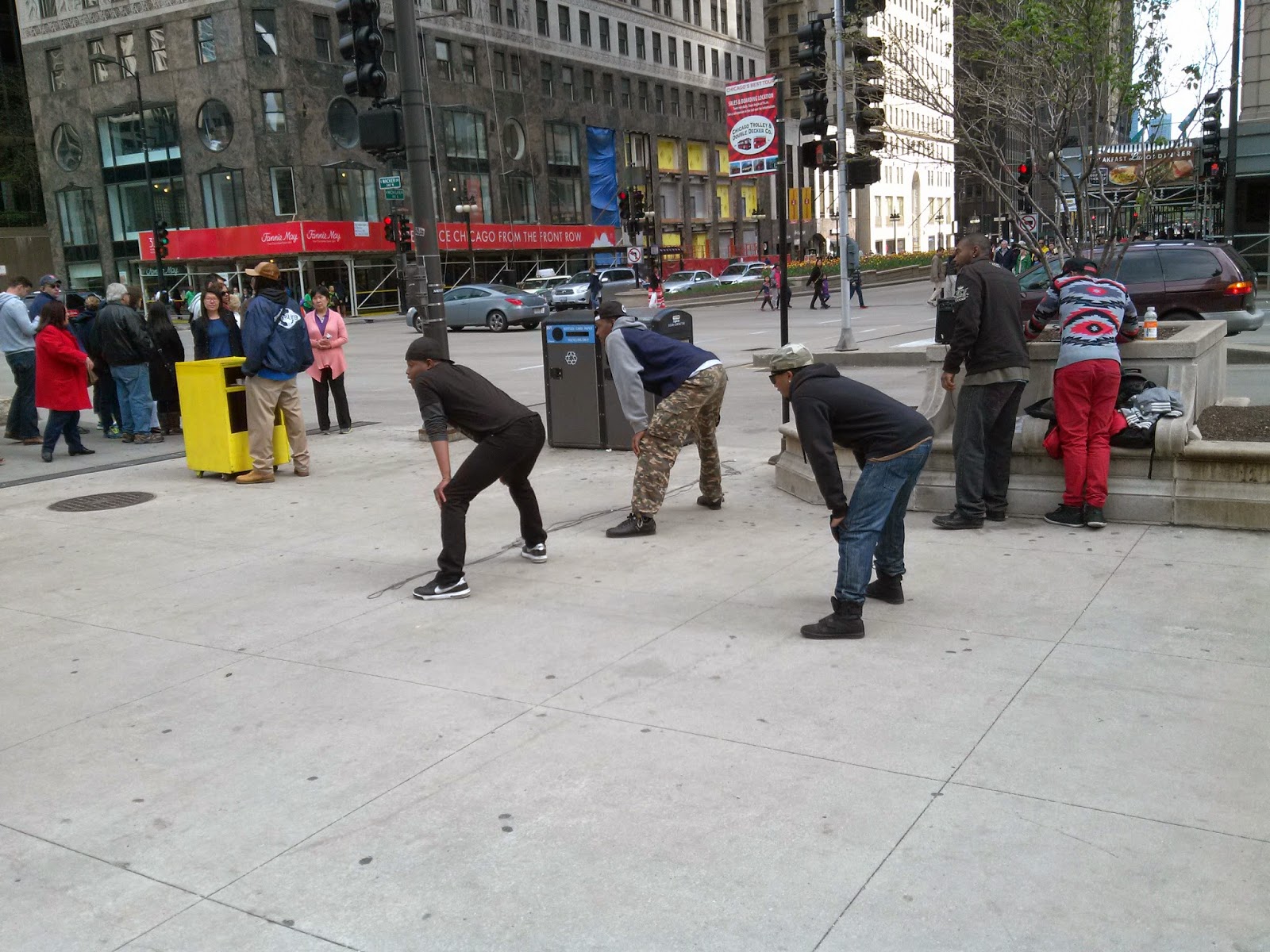
| The Kings of Michigan Avenue (the KOMA Krew) hard at work |
Hm. I had fun. Here's some money for you!
to
My money actually helped create the fun I just had!
that we get the distinctive urban vibe of street theater.
Sunday, October 26, 2014
Labeling Your Money
(Cuz sometimes it's easier to post on Sundays...)
A woman with a child beside her approached a balloon artist on the street. It was late afternoon at the Festival of Lights, Chicago’s annual Thanksgiving parade, and the sidewalks were quickly filling up with families. After taking a look at the balloon creations that adorned a sign that the man had set up, she asked the performer how much she should “pay” him for a balloon. He responded that there is no price, that he only takes “donations.” The woman suggested, then, that what the artist wants is like “a tip,” only to have the artist repeat that any money given is “a donation.”
He explained, “We don’t need any money. Give what you like.” Yet, despite this claim, a couple minutes later and in response to a man who only handed him a dollar in exchange for a gun-shaped balloon, the balloon artist directly met the man’s gaze: “I more than earned that, my friend. I more than earned what you gave me.” This man later returned to give the balloon artist an additional five dollars.
Here, then, is a “donation” – neither a “tip” nor a “payment” – that the performer does not “need” and yet “earned.” The work of balloon artists would appear to be the most straight-forward out of the different forms of performances buskers do; yet, in something as seemingly direct as a balloon in exchange for money, this particular performer refused to a payment. For this balloon artist, being paid in exchange for an object created and given implies “need.” In this view, he is not performing for money.
The “tip” has an interesting social history as something that once implied inferiority. Today, this same word has been redefined as, at times, as an entitlement (check out Viviana Zelizer's Social Meaning of Money if you're interested). But what about the term "donation"?
"Donation" implies charity and would therefore infer, even more than the “tip,” an unequal status relationship between the giver and the recipient. The balloon artist’s paradoxical statement that the donation is “earned,” and the giver’s subsequent acknowledgement of the performer’s self-proclaimed entitlement by returning with a five dollar bill, complicates this word choice and reveals a social struggle over the very meaning of the term “donation.”
Different street performers choose to label their money in different ways. Some ask for tips. Some insist on donations. And others even avoid labeling their money all together - these buskers are even more abstract in their word choice ("a little something") or extremely specific ("a five, ten, or twenty").
I'm going to end this week's post on that note. I'll talk a little bit more about this next week. In the meantime, if you're a performer, let me know how you label your money and why! I'm curious to learn what you think!
A woman with a child beside her approached a balloon artist on the street. It was late afternoon at the Festival of Lights, Chicago’s annual Thanksgiving parade, and the sidewalks were quickly filling up with families. After taking a look at the balloon creations that adorned a sign that the man had set up, she asked the performer how much she should “pay” him for a balloon. He responded that there is no price, that he only takes “donations.” The woman suggested, then, that what the artist wants is like “a tip,” only to have the artist repeat that any money given is “a donation.”
 |
| Mickey Mouse wants dollar bills!!! |
Here, then, is a “donation” – neither a “tip” nor a “payment” – that the performer does not “need” and yet “earned.” The work of balloon artists would appear to be the most straight-forward out of the different forms of performances buskers do; yet, in something as seemingly direct as a balloon in exchange for money, this particular performer refused to a payment. For this balloon artist, being paid in exchange for an object created and given implies “need.” In this view, he is not performing for money.
The “tip” has an interesting social history as something that once implied inferiority. Today, this same word has been redefined as, at times, as an entitlement (check out Viviana Zelizer's Social Meaning of Money if you're interested). But what about the term "donation"?
.jpg) |
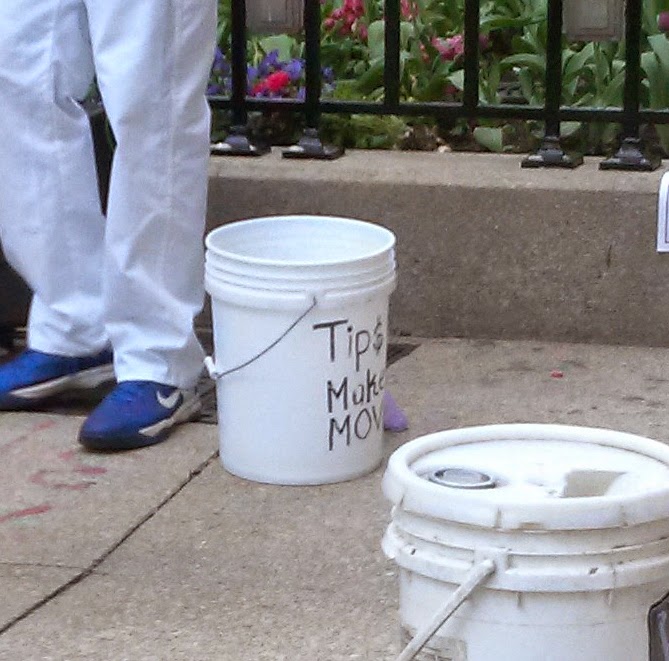
| Tips please! |
Different street performers choose to label their money in different ways. Some ask for tips. Some insist on donations. And others even avoid labeling their money all together - these buskers are even more abstract in their word choice ("a little something") or extremely specific ("a five, ten, or twenty").
 |
| Fat hats! That's what I want... pay me in hats. Or lemons. Though I hear lemon laws mean I get money back if you give me a lemon... |
 |
| I'm gonna call that one 'Tip.' That one is 'Donation.' And ooh! We'll call this one 'Benjamin.'' And this one looks funky. Nice to meet you, Jar Jar Binks. |
Subscribe to:
Posts (Atom)
