This week's post is an excerpt from my field notes. You've already met him before. Now you shall meet him again through my eyes.
2/1/2014
1:52pm-6:00pm
30˚F, snowing
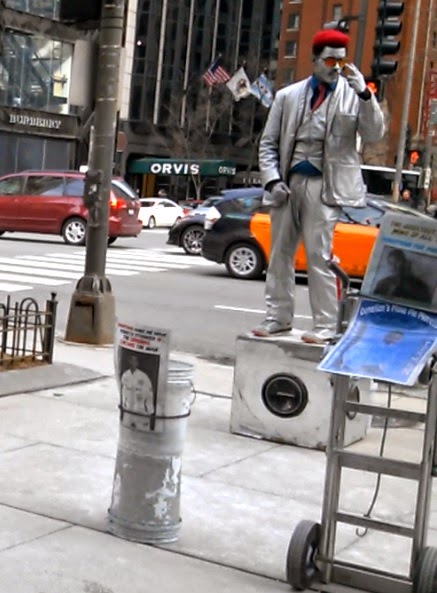 |
| The Tin Man identifying someone in the audience who has not paid him yet. |
I arrive at 1:52pm. I hear him before I see him. I slow down as I approach him from the south and watch a few other pedestrians look over in his direction. He sees me, continues to perform for a few more minutes, then hops off his box and turns off his music. He says that he has been out for about an hour already, and an hour is all he can do in this weather. He apologizes to me for needing to take a break as soon as I arrive. I tell him it’s not a problem.
He continues to pack up and tells me that normally he will take a break, drink some water or Gatorade, and take a smoke. Right now his toes are frozen. He takes all of his gear and starts walking south towards his car.
I ask him if he normally parks there. He says, no. He takes about three to four different routes to his car because he has been followed before, and he doesn’t want people to know where his money is. He gets some stares, and a few people wave. As we walk, a white 30-some year old man sees the Tin Man, and yells out, “Greetings from Earth!”
We walk to his car. He puts his stuff away, talking the whole time, and telling me how he would normally get a drink, but since he couldn’t get anyone to watch his stuff this time, he has to move everything with him. He loads his things into his car. I say we could go grab some coffee – I want to thank him for his time anyway. We go to McDonald’s, and we each get a coffee. He goes to a convenience store next to it, grabs a root beer and a cigarette.
We head back to the car. I climb into the passenger seat while he turns on the engine and cranks up the heat. We chat.
He asks me if I have ever heard of the saying, “Live by the sword, die by the sword.” People who live with guns will die by a gun, he explains. And him – he lives and works out on the street. Even in this weather, he will be out. He has to treat his work as a career if he is going to make any good money out of it. He doesn’t say it, but the implication is there: He lives by the street, and will die by the street.
Then he tells me that he has been going to open mics in Chicago, dressed up in all his silver. He’s been writing up jokes, and he thinks he’s ok. … He wants to practice stand-up comedy even though he doesn’t get paid at open mics. He says that he just turned 31 years old, and he can’t be working out on the streets when he’s old. He doesn’t want to be an old statue.
...He asks me what I plan to do after graduation. I say I’m not sure. I could end up anywhere at this point. He says that he remembers being at a crossroads. He could have continued in school and stayed in school for a long time, or he could have gone out to perform. He chose to perform. I ask him if he ever regretted making that choice. He says no.
He thinks what’s more important than just studying and finding a job that can make money for some other guy is knowing how to find money for yourself. He wants his son to learn that. Tin Man says he knows he can get money whenever he needs it, and he doesn’t need to depend on anybody else.
Then X (a musician who usually plays down the street from the Tin Man) calls Tin Man. X asks Tin Man how the weather is out there. Tin Man says it’s ok, but you won’t know until you come out. Afterwards, Tin Man tells me that since X knows that Tin Man is usually out there, X calls often to see how the weather and the crowds are.
We talk about the cold for a little bit. I mention that I met other musicians back before Christmas who were saving up to go to New Orleans. Tin Man says that X is also currently trying to raise money to go to New Orleans. It is supposedly warmer there, but we both heard that it was 30 degrees in New Orleans a couple days ago.
…We both climb out of the car and he starts packing his stuff up again. He starts playing some music in his headphones, trying to get back into the groove. When all his things are packed, he says to me, “Let’s roll!”
It is now 2:54pm.
Tin Man tells me that it’s supposed to be 30 degrees out, but he knows what 30 degrees feels like, and this isn’t it. Especially after the cold from these past few days, 30 degrees should feel like a heat wave. On our way back to Michigan and Ontario, a kid yells out at him, “Hey Robot Man!”
…Tin Man starts setting up in his spot. I notice a man sitting at the corner asking for money, just a little to the northwest of the tree where Tin Man performs. He gets up to leave when Tin Man’s music starts blasting.
A group of eight black teenagers stop to watch the Tin Man. One girl moves up and pats Tin Man on the arm. Two girls touch his hand, and Tin Man remains still. One of the boys asks loudly, “How do you stand like this?” The group of teenagers has now completely crossed over onto Tin Man’s “stage.” They are next to him, between the two trees, and behind his sign. One of the kids says, “Yeah, he’s real!” A boy reaches out to grab Tin Man’s right side. Tin Man suddenly reaches out at the boy, and all the kids scream and run back in front of the sign (and off the “stage”).
People are just watching. Nobody has tipped Tin Man yet. Then a man with a yellow jacket that says “Streets and Sanitation” moves up to drop a dollar into the bucket. A group of people have stopped to take pictures. Tin Man points at them. “Photos are for donations, ma’am. Thank you.” Nobody pays. After a moment, Tin Man turns off the music and hops off the box. The crowd moves on. He climbs on and starts the music again.
A white male, early 20s, has been standing to my right (by the south entrance to AT&T) watching since the music started. He is laughing. He tells me he likes to watch when people mess him [Tin Man] up. They like to mess with him, he tells me. And “He always says the same thing: Pictures are for money.” As we are chatting, two women take a photo. Tin Man notes that photos are for donations. The women leave without tipping.
…Two white women in their 30s stop in front of the Tin Man and read his sign. They make a donation then take a picture. The young man standing next to me who has been watching says, “He should just let people take pictures of him.”
Three white kids (pre-teen to early teens?) approach from the south. The two boys each have snowballs in their hands. The older boy gives a glove to the girl, reaches into his pocket, and takes out some money. He puts some money in the bucket. With the snowballs still in their hands, the boys each stand on either side of the Tin Man. The girl takes a picture of them.
Later, when I ask the Tin Man what went through his mind when he saw the boys with the snowballs, Tin Man says he wasn’t too worried. The snowballs were clean and white and big. It looked like they had been working on them for some time. They weren’t just going to waste it on him. Unlike, he notes, something that happened yesterday when a man got mad at the Tin Man for not moving after he had dropped a donation. This man picked up some snow and threw it at the Tin Man. The Tin Man looked at this man and asked him what he was doing. The man just walked away.
…A group of 5 Chinese tourists stop to take a picture. The Tin Man signals for them to give him donations. They step back for a second. As they leave, they say 要给钱才能照啊。”Must pay before we can take a picture,” they note. They all look at each other, then turn and leave.
…A white couple (mid-30s) stops for a second to watch. The man says something about giving Tin Man a couple of dollars. The woman does not seem happy. They bicker. They both go inside the AT&T store. Inside the store, I see the woman take out $2 and hand it to the guy. After a while, the man comes back out with his hands in his pockets. He walks up and watches the Tin Man.
Meanwhile, three young men (late teens?) walk past quickly. One of them turns back, looks at Tin Man, and yells out, “Ain’t you cold, brah!” He looks back at his friends. “Let’s watch him.” They don’t stop, so he turns and walks away.
After watching for a couple of seconds, the man steps up and drops the money. The woman comes back out from inside the store and stands next to him. I walk up to them and chat. They are tourists from Oklahoma. I ask, “What went into your decision to pay him?” The man points, “That guy?” Then he practically yells out, “I want to see him move!” I nod and thank them. The woman purses her lips. They leave.
A black couple stops by. The woman drops some money in. She watches Tin Man, who does not move. She says, “I wanna see him move! He won’t move! He’s trying to take my money!” Then Tin Man points to some girls who are standing in the back. The girls turn and leave.
I catch up with the girls as they wait at the crosswalk and chat with them. They tell me they are students from Loyola. When I ask what they think of the Tin Man, they say, “He’s awesome!” They like him a lot. I ask them why, then, did they decide not to tip. One of the girls say, “He only dances for people who tip him, and he asked us for money, and we don’t have money.”
Three white men in their 40s walk past. One of them says to the other two, “You gotta give him money, or he won’t move!” They are at the crosswalk heading east and watching from there. He says to his friends (but addressed to no one in particular), “Come on, someone give him money!” Then the pedestrian crosswalk sign changes to a GO, and he says, “Dang it!” They walk away.
…One black woman in her early 30s walks past, drops a dollar, and keeps on walking. She does not stop to watch. I catch up with her and ask her what she thinks about the Tin Man. “He’s very interesting and unique, especially to be out here in this weather.” She says that she lives in the Chicago area, but this is her first time seeing him.
This is the first time I see her too, but Tin Man later tells me that she was here a couple hours ago. She said “You’re still here?!” before dropping a donation. He says that he recognized her because of her fur coat.
…A white woman (40s?) standing in front of me tries to take a picture of the Tin Man on her cell phone. The Tin Man points to her and says, “Photos are for donations please.” The woman stops and steps back to another white female (also 40s) who had been standing next to me, and complains. “Just not worth it!” I ask her why. She says that she wanted to take a picture for her nephew. She lives in Chicago, but this is the first time that she has seen the Tin Man. She didn’t like the music. “The music is… weird… techno stuff?” The other woman who is with her is, however, smiling, and seems to enjoy the show more. “He’s really good when he does that!” She points at the Tin Man, who is in a pose with someone for a picture. Neither one of them pay though. The first woman tells me, “I just don’t get what he’s doing. Like, if he were… Donald Duck… and the music, I don’t get it.” I thank them. They stay and watch a little bit longer, then walk away.
Tin Man turns the music off and takes a break. We head into AT&T to warm up. There is a man there who Tin Man had waved to earlier, and the two of them talk. Tin Man is talking about how well he is doing right now. “They just started to drop it now!” He mentions that they must have all gone to the ATM or something. But, “My toes gone now!” “It’s just now starting to pick up.”
The time is 4:10.
He tells his friend that he is going to take a break. This time, Tin Man grabs his bucket of money and leaves everything else behind. The man I had just met stays behind in the AT&T store and watches Tin Man’s stuff.
We head back to the car to warm up. Tin Man says that he pays someone – and usually, only this guy shows up. Other people know, but no one else shows up when they say they will – to watch his stuff. He’ll pay $5 to $6 to watch his stuff for thirty minutes, and $8 to $10 to watch it for an hour.
He notes that since it is picking up, he wants to go back out and perform, even though the “nights are for weirdos.” The summer time is better to perform in. I ask, “Even though there is more competition?” Tin Man laughs and says, “Competition doesn’t exist.” He is, in his words, a “big shark in a small pond.”
He asks me if I have ever heard JZ’s quote, “A drought can define a man when the well dries up.” He says right now, in the winter, the well is dry, and he is still working out there. I nod. I say, “And X hasn’t shown up yet?” Tin Man says, “Told ya. He went to the subway, probably.”
Then he tells me about a time when AT&T asked him to leave because they wanted to film something in his spot. Tin Man says that he had as much of a right to be there as anyone else, and he isn’t going to leave as long as he’s making money. The security guard leaves and comes back with a hundred dollars and tells him he can come back in about two, two and a half hours. Tin Man says OK! and leaves. Later, another AT&T security guard who was a former police officer accuses Tin Man of bribery, and threatens to get him charged with it.
Tin Man says that 90% of the game is psychological, 10% physical. Their game (the police/security) is to make you want to quit and go home. Every year, Tin Man says he has to deal with rookie cops. “New rookie cops every year, same problems.”
Then he says, “If you are going to be doing this research out here, soon or later, you’re going to have to start writing about race.” He goes on to say, “Life would be completely different if I were a white guy in silver.” He says that once there were a group of older women watching him. When he asked for donations, one of the women dropped a note. The Tin Man read the note, and it was, he says, a racist letter. He didn’t know how she managed to write an entire racist note and drop it in his bucket. He says they were “the Klan wives or something.”
…We leave the car (5:10pm).
…We walk past the AT&T store, turn west around the corner, and each take a bathroom break at the Grand Lux. When I get back to the performance spot, Tin Man is in AT&T, speaking with his friend. An older (50s?) white man walks up and asks Tin Man how he is doing. Tin Man says he’s doing well. The man asks Tin Man if it’s cold out there, and if he’s going to be out there much longer. Tin Man says he’ll be out there as long as there’s money to be made. Out he goes. The man who had been watching Tin Man’s stuff for him leaves. As soon as we are out of the AT&T, Tin Man turns to me with a big grin on his face. That was the security guy who accused him of bribery last time, he tells me. “He’s just noseying around.”
…At 5:30pm, Tin Man starts playing music and climbs onto the box.
A family – husband and wife (late 30s to early 40s) with two sons (8-12 years old) take a picture with Tin Man and drop some money. The woman tells me that they like him. “Tin Man’s been up here for years. That’s how he makes his living.” They were in Chicago and wanted to bring their kids up here to see him.
I watch three tourists enjoy the show then walk off without paying. They are from Missouri. The three white women – an older woman and her two daughters, possibly – tell me that they think the Tin Man is “cool.” When I said that I was interested in how people decided whether or not they should tip, the older of the two daughters explained that they “just didn’t want to spend the money.”
A woman who is walking south sees the Tin Man and exclaims, “Oh, so that’s where it’s [the music?] coming from!” She continues to walk by without stopping.
At 6:00pm, Tin Man stops the music. He climbs off and comments that today “they tipped more in the evening than in the morning” which, he has said before, is usually the other way around. …Now, since “the crowds are starting to thin out,” Tin Man packs up. “Now you know how I call the day,” he says.